Scientific Advisory Committee

Professor Ian Horrocks
ian.horrocks@cs.ox.ac.uk
University of Oxford, Department of Computer Science
Ian Horrocks is professor in the Oxford University Department of Computer Science and a visiting professor in the Department of Informatics at the University of Oslo. He leads a research group at the Oxford University Department of Computer Science working in the area of Knowledge Representation and Reasoning, and in particular on the development of logic-based ontology languages and reasoning systems to support ontology engineering applications,
Professor Horrocks' research covers knowledge representation, ontologies and ontology languages, modal and description logics, automated reasoning, implementation and optimisation of reasoning systems, and applications in areas such as e-science and the semantic web. He was an author of the OIL, DAML+OIL, and OWL ontology language standards, chaired the W3C working group that standardised OWL 2, and developed many of the algorithms, optimisation techniques and reasoning systems that underpin OWL applications. He has participated in numerous national and international research projects, and was Scientific Director of the FP7 IP Optique project and Scientific Director of the SIRIUS Centre. He is a Fellow of the Royal Society, a member of Academia Europaea, a Fellow of the European Association for Artificial Intelligence and a Fellow of the British Computer Society. He has published more than 200 papers in major international conferences and journals, winning best paper prizes at KR’98, AAAI-2010, and IJCAI-2017, and a test of time award at ISWC-2013. Ian Horrocks is also founder of Oxford Semantic Technologies and editor-in-chief of the new open access jounal Transactions on Graph Data and Knowledge (TGDK).
|
|
sofia.olhede@epfl.ch
EPFL Lausanne, Switzerland, Institute of Mathematics
Sofia Olhede is a Statistics professor. Her research focuses on stochastic processes, time series, random fields, and networks. She contributed to establishing the UK national data science institute, the Alan Turing Institute, and chaired its science committee, overseeing a £500,000 scientific program.
Sofia has served on the Royal Society and British Academy Data Governance Working Group and the Royal Society working group on machine learning. Recently, she was a commissioner on a law society commission studying algorithm use in the justice system.
|
 Professor Barbara Plank Professor Barbara Plank
b.plank@lmu.de
Ludwig Maximilian University of Munich, The Center for Information and Language Processing
Barbara Plank is a professor for AI and Computational Linguistics at LMU Munich, Co-director of the Center for Information and Language Processing (CIS) and Head of the Munich AI and Natural Language Processing (MaiNLP) research lab.
Her research focuses on robust machine learning for Natural Language Processing (NLP) with an emphasis on human-facing and data-centric approaches.
|
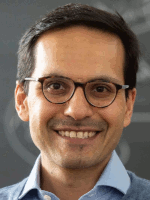 Professor Sach Mukherjee Professor Sach Mukherjee
sach.mukherjee@mrc-bsu.cam.ac.uk
University of Cambridge, MRC Biostatistics Unit
Sach Mukherjee is Head of Statistics and Machine Learning at the German Center for Neurodegenerative Diseases (DZNE), one of Germany's major biomedical institutions, and Director of Research in Machine Learning for Biomedicine at the Medical Research Council (MRC) Biostatistics Unit, University of Cambridge. He earned a DPhil in machine learning at Oxford, was a postdoctoral fellow in statistics at the University of California, Berkeley and has previously held faculty positions in Warwick and Amsterdam.
He is a principal investigator in several consortia at the intersection of AI and medicine and has served in leadership and advisory roles spanning statistics, machine learning and the biomedical sciences. His research centres on machine learning methods for large-scale biomedical data, with specific interests in high-dimensional models, causality, data heterogeneity and networks. He has been a Fulbright Fellow and a recipient of the Wolfson Research Merit Award of the UK Royal Society.
|
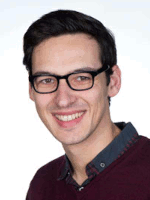 Professor Christopher Nemeth Professor Christopher Nemeth
c.nemeth@lancaster.ac.uk
Lancaster University, Mathematics and Statistics Department
Chris Nemeth is a Professor of Statistical Machine Learning in the School of Mathematical Sciences at Lancaster University. He previously received an EPSRC Innovation Fellowship on Scalable and Exact Data Science for Security and Location-based Data and currently holds a UKRI-EPSRC Turing AI Fellowship on Probabilistic Algorithms for Scalable and Computable Approaches to Learning (PASCAL). Chris was previously the chair of the Computational Statistics and Machine Learning section of the Royal Statistical Society and is currently an Associate Editor for the journals Data-Centric Engineering and Transactions on Probabalistic Machine Learning. He is the Co-Director of Lancaster University’s Data Science Institute DSI and Lancaster University’s machine learning lead in the N8 CIR, as well as a Co-I on the EPSRC-funded Prob_AI Hub.
Chris Nemeth’s research lies in the areas of computational statistics and probabilistic machine learning, specifically Markov chain Monte Carlo, sequential Monte Carlo, Gaussian processes and approximate Bayesian computation. His current research is focused on Bayesian methods for large-scale datasets and tools for online learning. He also works on problems related to Gaussian processes and network modelling, developing probabilistic AI algorithms for large-scale learning, with a focus on the mathematical foundations of these algorithms.
|
Published Nov. 3, 2023 10:49 AM
- Last modified Feb. 24, 2025 3:28 PM

 Professor Sofia Olhede